With a special composition that contributes to the birth of healthy lambs and calves.
Protects against grass staggers when, in the springtime, animals are fed out on lush pastures.
Ideal for the grass feeding period
Benefits
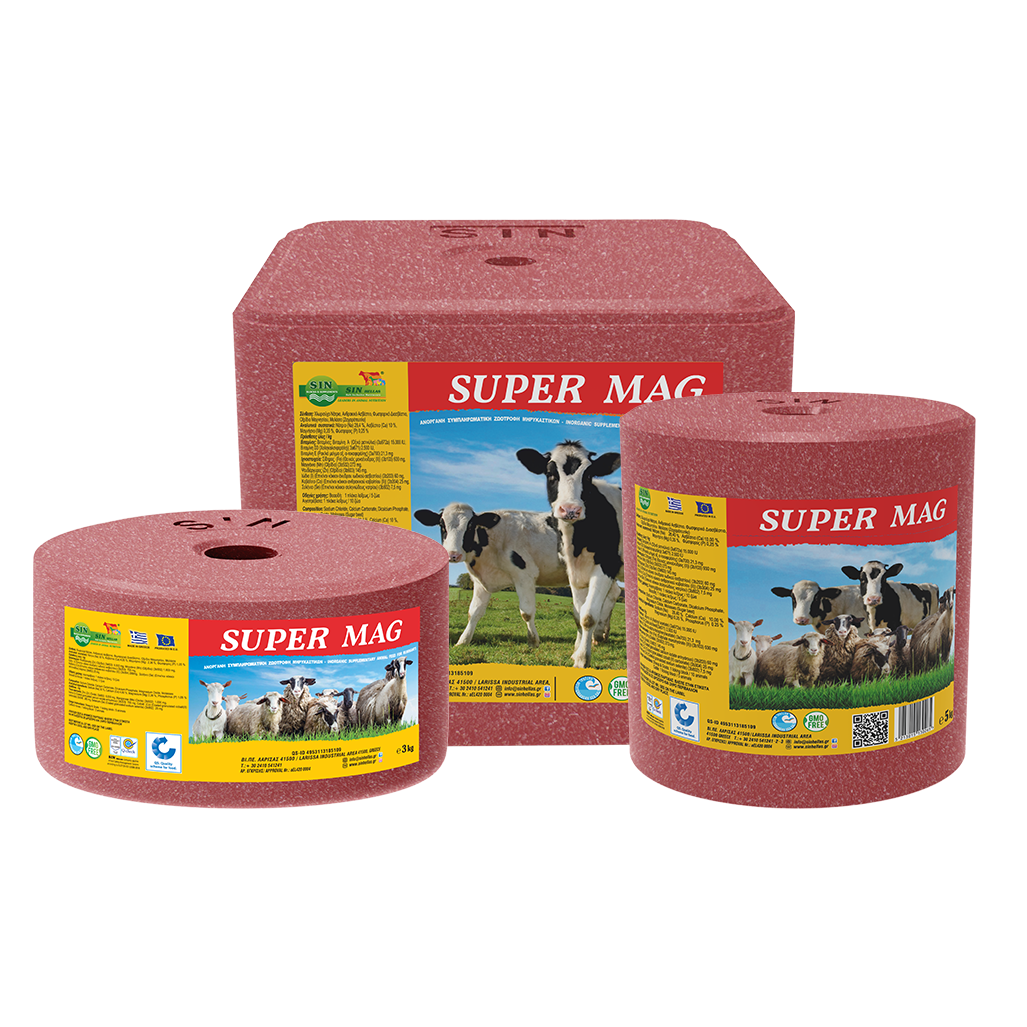
SUPER MAG is a high-magnesium mineral supplement designed to support optimal health and performance in ruminants. Its bioavailable magnesium content helps prevent hypomagnesemia (grass tetany), particularly in lactating cows, ewes, and young stock grazing on lush pastures.
By providing essential minerals and electrolytes, SUPER MAG promotes stronger immunity, improved fertility, and higher-quality colostrum, ensuring that newborn lambs and calves start life healthy and vigorous. Regular intake supports metabolic stability, stress resistance, and overall vitality, making it an essential supplement for all classes of grazing livestock.
By the term Hypomagnesaemia we mean the low-below normal level- blood content in Magnesium.
Hypomagnesaemia is one of the most serious (if not the most serious one) food borne illnesses of the extensive and semi-subsistence farmed sheep and goats and this is because its finding is taking place after one or more animals’ deaths occur. But also because its preventive and therapeutic treatment adds a relatively high cost to the farm’s operational expenses.
Sheep and goats are not capable of “stocking” Magnesium in their body for a long period, and this is more intensive in adult animals getting even more intense as they grow older. So in an emergency situation the small Magnesium stock quantity is running out very quickly thus resulting to Hypomagnesaemia disease and its consequences.
The unique Magnesium intake source for the animals is their ration which should contain sufficient quantities of this macro-element. As except from the fact that the Magnesium stock in animals’ body is not quite big, there is also a continuous Magnesium loss by the milk and by the animal’s secretions (urine, sweat, e. t. c.).
The most sensitive to this problem animals are ewes and goats with high milk productivity and those which are breastfeeding mulberry lambs or kids and their nutritional status indicator is below 2,5.
The disease occurs more often in the aged ewes and goats in which the body’s stocks in Magnesium are within the limits of exhaustion.
The disease appears in Spring season when the animals are starting to be fed out in the pastures or in Autumn after the first rains season and the germination of grassland plants. This happens because of the feeding of the animals in the rich in grass pastures which also means a changing of the animals’ ration by stopping feeding them mainly with cereals and other coarse animal feeds and by limitation or even stopping completely the compound and concentrated feeding inside the stable.
Compound feed, usually contains a premix of minerals and vitamins, thus its reducing or even its complete stopping implies to the discontinuity of inorganic elements and vitamins supplying and thus in Magnesium too.
So the animals’ feeding is based mainly in grazing the new, fresh spring grass or in the case of artificial pastures in grazing grass plants after winter lubrication with nitrogen or potassium fertilizers.
2. Main Reason of Hypomagnesaemia
The fresh spring grass of the natural pastures but also the growing grass plants of the artificial pastures are very poor in Magnesium, so the Magnesium intake through grazing is very small and limited.
The grass mass of the natural and artificial pastures that the animals intake during grazing in Spring time, is an easy coarse food as the celluloses percentage is small. As a result the period of staying inside the animal’s peptic tube is very small thus the Magnesium absorbance becomes less efficient.
The Protein content in the grass of the natural and artificial pastures is very high so its decomposition in the big belly results to the production of free Ammonia which together with Magnesium forms insoluble salts making its absorbing even more difficult.
Magnesium is generally less available in acidic grounds and in most countries most of the grounds are acidic, so the Magnesium is always available in small and insufficient quantities.
3. Symtoms
The disease symptoms last for a short period of time and what usually the farmer sees is one or more dead animals. The initial symptoms are jogging, dullness with stretched back legs and often head headed to the back, involuntary spasms of the facial muscles, frequent urination, sudden idleness, teasing of the teeth, spasms (tingling), abdominal depression with the front legs crossed as a scissors, stretched throat and head, foams in the mouth and finally death.
It must be noticed that the sick animal shows an intense reaction in noises and steep movements and maneuvers, so the animal’s capture and manipulation should be done very carefully as they cause a big stress to it with severe spasms and possible death.
4. Treatment
If the animal is found to be in the initial stages of the disease with the above mentioned symptoms, the animal’s handling by the farmer should be done with great care especially during its capture. The immediate intravenous or subcutaneous solution of 20-25% of borogluconate calcium and 5% magnesium is necessary. The farmer must isolate and monitor the animal until possible spasms, unstable walking and other symptoms have stopped. If the animal is positioned in abdominal depression the farmer should correct its position by lifting it so as it rests on its stern and supports it from the sides in some way (usually with a bundle of straw), to avoid its possible drowning.
After the animal starts recovering and regain its senses, it should stay isolated until full recovering. A ration in which a sufficient quantity of premix has been added, should be fed to the animal.
5. Prevention
As previously mentioned, the main cause of the disease is the sudden ration change which takes place when the animals start being fed out in the open pastures, and also the reduction or even completely stopping being fed with compound feeds in the stable, as it is the compound feed mixture in which a quantity of 2-2.5% premix has been added, that ensures the daily required Magnesium quantity to the animals.
Additionally the animals’ free access to licking blocks enriched with sufficient quantities of Magnesium, such as the S.I.N. HELLAS SUPER MAG licking block can significantly help the prevention of the disease.
Other prevention tactics can refer to acidic grounds-being used as artificial pastures- improving, incorporating limestone (500-1000kg/ 1000sqm) , or fertilization of these pastures with suitable mixtures containing Magnesium.
It is easily understood that Hypomagnesaemia is not difficult to be controlled provided that the above mentioned prevention measures are taken, the use of a premix in the TMR and of special Magnesium licking blocks such as the SUPER MAG, being the easiest and most cost effective among them. Their use should be constant, during the whole year round, and in all animals’ stages of production.
6. Conclusion
SUPERMAG BLOCK Contains a high level of magnesium (2.36 %) in combination with a high level of Calcium (4.60 %) and Phosphorus (1.05 %) together with the addition of a full range of minerals and trace elements. This valuable source of additional Magnesium is especially useful in helping to protect against grass staggers when stock is turned out onto lush pastures in the spring. These blocks are ideally suited to dairy cows, sheep and goats, while when fed to horses their high Magnesium contest prevents Laminitis.
Calcium is the main component of bones and teeth. It has chief metabolic functions in the animal bodies and is also essential for muscle activity, skeleton, blood clotting, nerve transmission and dynamics of enzyme function. Calcium metabolism at calving is one of the most important animal health factors influencing the production, reproduction and feed conversion efficiency as it plays a major role in the absorption of nutrients (modification of the cell permeability).
Zinc is an essential nutrient for animals, functioning in enzyme systems and being involved in protein synthesis, carbohydrate metabolism, and many other biochemical reactions. Severe zinc deficiency causes numerous pathological changes, including skin parakeratosis, reduced or cessation of growth, general debility, lethargy, and increased susceptibility to infection.
Magnesium is needed for more than 300 biochemical reactions in the body. It helps to maintain normal nerve and muscle function, supports a healthy immune system, keeps the heartbeat steady, and helps bones remain strong. It also helps adjust blood glucose levels. It aids in the production of energy and protein, improves the digestibility of feed and improves the reproduction.
Manganese is concentrated in the animal bones. It is an important cofactor for many enzymes involved in energy and protein metabolism. Mn is also required for mucopolysaccharide synthesis. This is a major component in the organic matrix of bones. Consequently, deficient animals have normal tendon growth but slow bone growth. This leads to symptoms such as perosis in chicks and crooked calf in other animals.
Phosphorus is very important for all animals for healthy muscles, bones and teeth development, steady digestion, healthy function of the energy metabolism and is an inevitable macro element for reproduction. Deficiency of Phosphor will cause the body to use up phosphor reserve in bone tissues as compensation, however if it isn’t replenished in a short period, issues will arise in all bodily functions and will cause the animals to eat objects with no nutritional value.
Selenium is a component of glutathione peroxidase, an enzyme for the removal of lipid peroxides. Selenium is very important in fertility and helps muscular development. Se is also a component of two other selenoproteins. The midpiece of sperm requires selenoprotein. Microbes in the rumen replace S with Se in their S-containing amino acid synthesis. They are absorbed in the duodenum as amino acids. White muscle disease and exudative diathesis are two Se deficiency symptoms, which can be treated with both vitamin E and Se. Deficient animals also show liver necrosis. Selenium prevents oxidative damage to tissues by offering an antioxidant action and protects against cell damage.